

For yam farmers in Côte d’Ivoire, production of a good harvest is only a small part of the journey. They soon begin another race against time after months of cultivating, these farmers face the challenge of protecting their yams from rotting before they reach the consumers. Every tuber of yam lost means less food reaches consumers and less income reaches farming households. In a country where yam is a staple food and important source of livelihood, reducing post-harvest losses is very crucial. It is about reducing post-harvest losses, protecting income and strengthening food security by ensuring whatever the farmer produces reaches the table. Sub-Saharan Africa supplies 95 per cent of the world’s production of yams, while West Africa contributes 89 per cent of this proportion. Côte d’Ivoire is the world’s third largest producer. (Kouakou et al. 2024). According to a 2022 study by Kouadio et al., published in the Open Journal of Applied Sciences, rot affected between 22.86 per cent and 60 per cent of Kponan yams across the experimental groups after three months of field storage in Côte d’Ivoire.It is against this backdrop that the project Sustainable and Innovative Yam Production through Post-Harvest Pest Control, implemented by Prof Brahima Camara and partners at the Université Félix Houphouët-Boigny (UFHB), set out to address.
To tackle this challenge, the researchers developed solutions that could help protect the harvested yams from rotting and reduce loss after harvesting.
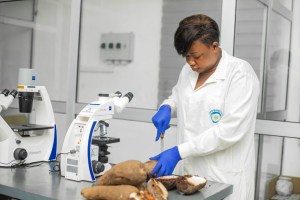
According to Prof Camara, their project addressed a very specific problem: the rotting of yams in traders’ stocks.
“Over recent decades, storing yam tubers had become increasingly difficult due to their early and widespread rotting, leading to significant food and economic losses. For producers and traders, this meant losing part of a product in which they had already invested labour, money and time. In some of the shops surveyed, rot rates reached 32 to 34 per cent,” said Prof Camara.
Two biological solutions
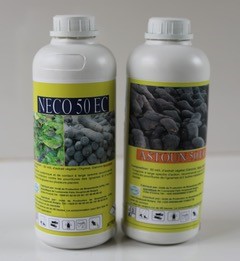
To understand the cause and identify a suitable solution, they embarked on a study to identify the pathogens responsible for the rot and to evaluate biological solutions suited to local conditions. The results validated two biopesticides, NECO and ASTOUN, and led to their approval for use in the yam sector in Côte d’Ivoire.
NECO and ASTOUN are biopesticides formulated from plant extracts. “These extracts contain active substances capable of inhibiting the growth of the fungi responsible for yam rot. Their use therefore helps to protect the tubers after harvest and extend their shelf life,” he highlighted.
What sets these biopesticides apart is that they harness the antifungal properties of plants to offer a biological alternative to conventional treatments.
“Their plant-based formulation is designed to provide effective protection whilst minimising risks to consumers, traders and the environment,” he added.
“Under our experimental conditions, they demonstrated better average performance in inhibiting fungal growth than the synthetic reference product. We also found that preventive application was more effective than treatment after infection. They must therefore be applied early enough and used in conjunction with good handling and storage practices,” Prof Camara recalled.
“The most telling results relate to the trials carried out in storage facilities. In Abidjan, on the Assawa variety, the first symptoms appeared after ten weeks with ASTOUN, compared with five weeks without treatment. In Korhogo, with NECO, they appeared after eight weeks, compared with three weeks in the control group,” Prof Camara explained.
In both cases, the treatment delayed the onset of the rot, giving traders more time to sell their stock.
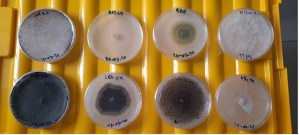
“Laboratory trials also showed an average inhibition of fungal growth of 84.58 per cent with ASTOUN and 66.01 per cent with NECO, compared with 51.76 per cent for the synthetic fungicide used as a reference,” Prof Camara confirmed.
While scientific results demonstrates the potential of the products, their significance relies on feedback from the users. Prof Camara notes that feedback from traders gives a human dimension to the results. “In a France 24 report on the work of Adjata Kamara, the young researcher in our team, a trader described that using the product enabled him to preserve his yams more effectively. He said they now make profit.’”
This trader’s account illustrates the value of the innovation in economic stakes.
This experience is consistent with the results of our trials. Traders now have an opportunity to protect more of their stock value and reduce losses.
The research team has involved traders in monitoring treated tubers in their shops,
enabling the researchers to asses the product under real-world storage conditions and to better understand the practical constraints associated with their use.
Investment in African research capacity
Behind the development of NECO and ASTOUN is an investment in African research capacity aimed at addressing practical development challenges.
Prof Camara pointed out that funding from The Partnership for Skills in Applied Sciences, Engineering and Technology (PASET) Regional Scholarship and Innovation Fund (Rsif) was crucial, as it fully supported the study.
“It enabled us to investigate the fungi responsible for yam rot, to evaluate biopesticides in the laboratory and to test their effectiveness under traders’ storage conditions. This continuity of funding enabled us to build the scientific evidence needed to take the findings forward towards practical application,” Prof Camara added.
For the research team, the experience demonstrates how sustained investment can help African researchers develop solutions tailored to local agricultural challenges. “From a scientific perspective, this support has strengthened our understanding of post-harvest rot and enabled us to validate biological solutions suited to the Ivorian yam sector. It has thus contributed to the process leading to the registration of NECO and ASTOUN. For our team, this is a powerful illustration of the capacity of African research to address the challenges faced by local communities, provided it is given the appropriate resources,” Prof Camara observed.
The potential benefits extend beyond producers and traders, this investment opens up concrete prospects: better protection of stocks, reduced losses and safeguarded incomes. For consumers, the aim is to ensure that more yams remain available for consumption.
In this way, the project illustrates how investment in African research can help connect scientific inquiry with the everyday needs of communities and contribute to food security. PASET-Rsif’s support has therefore helped to bridge the gap between scientific research and the needs of the population.
The registration of NECO
We must turn proven efficacy into a product that is readily available, reliable and affordable. This requires scaling up production, maintaining the quality of the formulations and organising their distribution. The top priorities for Prof Camara and his team are to secure raw materials, ensure suitable equipment is in place and standardise manufacturing. “Each batch must be of consistent quality. Training is equally important. Users must understand the timing of application, the conditions of use and the storage practices associated with the treatment,”he said. He added that cooperatives and distributors can play a vital role in this roll-out.
In the future, additional support could help to expand production, equip demonstration sites and extend the distribution network. “We would measure results in terms of the number of regular users, the tonnes of yams treated, the kilograms of losses prevented and the net profit per user,” he noted.
Prof Camara indicated that this innovation goes beyond solving the rot but also boosting food security,
Protecting yams after harvest means preserving food that has already been produced. It also means making better use of the resources and effort invested in their production.
For producers and traders, improved preservation can help secure incomes and limit the need for emergency sales. For markets, it can facilitate stock management and ensure continuity of supply.
Local production of biopesticides could also foster activities centred on plant-based raw materials, formulation, packaging, distribution and user advice.
From an environmental perspective, preventing losses would make better use of the resources already used to grow and transport yams. “We must, however, continue with assessments to quantify the specific environmental benefits of these products,” Prof Camara indicated.
The effectiveness of biopesticides against several fungi, on two varieties of yam and in several towns, has encouraged Prof Camara and his team to continue promoting their use, whilst taking into account the diversity of situations.
He pointed out that to extend this innovation to other farming communities or producing countries, it will be necessary to conduct local trials, verify its effectiveness against the relevant varieties and pathogens, and comply with authorisation procedures. He added that it will also be necessary to demonstrate its cost-effectiveness for users and to build local partnerships for production, training and distribution.
Sustaining the journey from research to impact
Prof Camara reiterates that the registration of NECO and ASTOUN by the Ministry of Agriculture, Rural Development and Food Crops is a major milestone. It forms part of a validation process involving the identification of fungi, laboratory trials, experiments on tubers and evaluations in shops. However, registration is only the beginning of the journey towards widespread use. The next challenge is to ensure that the products are consistently manufactured, affordable and accessible to the producers and traders who need them.
“Challenges that remain to be addressed are financing production equipment, ensuring a steady supply of raw materials, maintaining batch quality, and making the products accessible to users.”
“Our team’s institutional anchoring, full funding from PASET-Rsif and the participation of retailers have provided essential support. The authorisation obtained now makes it possible to envisage a more structured roll-out,” he noted.
Realising the full potential of NECO and ASTOUN will require continued collaboration among researchers, public authorities, regulatory bodies, businesses, cooperatives and development partners.
Public authorities can support investment and the dissemination of information. Regulatory bodies play a central role in monitoring compliance and overseeing conditions of use. Research institutions must continue to assess stability, safety and economic performance. Businesses can provide manufacturing and distribution capacity, whilst cooperatives can facilitate training and collective purchasing.
For the research team, product registration is an important step towards making the innovation available to more users. Yet the next phase will determine whether the products can move from promising research results to sustained, widespread adoption.
For PASET-Rsif, the project offers a practical example of how investment in African research can support the development of solutions to challenges affecting agriculture and food security.
The opportunity now is to build on the scientific evidence, strengthen the systems needed to deliver the products, and measure their benefits for farmers, traders and consumers.
The potential also extends beyond Côte d’Ivoire. With further testing and the necessary regulatory approvals, the approach could be adapted to other yam-producing regions facing similar post-harvest challenges. Expanding its reach could help preserve more food, protect livelihoods and create new opportunities along the agricultural value chain.
The progress of NECO and ASTOUN demonstrates what investment in African research can achieve: locally developed solutions that respond to real challenges and offer practical benefits to communities. PASET-RSIF’s support helped the research team move from investigating the causes of yam rot to validating biological treatments and advancing them towards registration.
The priority now is to build on that achievement. By investing in production, distribution and wider adoption, development partners and governments can help take an already registered innovation to more communities—protecting more harvests, reducing post-harvest losses and ensuring that more of the food farmers produce reaches the people who need it.